

Showing posts with label Internal Combustion Engine. Show all posts
Working of Six Stroke Engine
You might be thinking this that i've gone mad, but a man naming Bruce Crower did so. And you know what he got, he got an addition two stroke which not only improves efficiency of the engine by 40% but also reduces pollution.
Actually the engine starts with an regular Otto cycle or 4-stroke cycle delaying the 5th and the 6th stroke. Once the engine's temperature reaches 204.44 degree C water is induced in the cylinder after the Exhaust stroke or the fourth stroke. Water expand to 1600 times its volume and forces the piston down for an additional stroke and thus an extra power stroke adds up giving extra benefit to the engine. This type of engine don't want an cooling system because the water based cooling system has added an extra power stroke to the engine. Now we all know water is an renewable resource hence after the water based power stroke, this water is collected back by a condenser attached with the exhaust pipe. Hence this water can be used up again as a fuel for 5th and 6th stroke.
Let's understand it better via a Diagram:


2nd Power Stroke: This is the stroke where water is injected inside the engine so that it pushes the piston down. Hence an extra power stroke has been added which would again provide more power with better efficiency.

Actually there are various proposed 6 stroke engine but currently notable designs in this class are the Crower six-stroke engine, invented by Bruce Crower of the U.S. which we have learned; the Bajulaz engine by the Bajulaz S.A. company of Switzerland; and the Velozeta Six-stroke engine built by the College of Engineering, at Trivandrum in India.
How Diesel Engine Work
One of the frequently asked questions to me from numerous people was "How diesel engine differs from a gasoline engine"
Both are internal combustion engine, both of them run on a 4-stroke cycle known as Otto-cycle, both convert chemical energy of fuel to mechanical energy by a series of small explosion in large number. So what's the basic difference, huh. The basic difference lies in the way fuel is induced in both the engine's cylinder. For better understanding of Diesel engine, do read our "How gasoline engine works" or 4-stroke engine works section and come back fast because now unfolding the biggest mystery of engineering that How Diesel Engine Work.
Technically, the difference between these engine lies in their Intake Stroke and Compression Stroke. In diesel only air is induced into the cylinder during Intake Stroke. Now piston moves up and compression stroke begins, this compresses the present air in the cylinder. The temperature of the air increases because on compressing or on reducing its volume the temperature of the air increases. Once the piston reaches the top or compresses the air fully, fuel is induced in the system. The temperature of the cylinder or system is high enough to ignite the fuel sprayed. An explosion occurs or Combustion Stroke begins this drives the piston back and after-that emission Stroke Occurs.
Diesel engine too have a 4-stroke cycle. These are:


Everyone has its pros and cons. Let's talk about the advantages and disadvantages of a diesel engine.
Pros
Both are internal combustion engine, both of them run on a 4-stroke cycle known as Otto-cycle, both convert chemical energy of fuel to mechanical energy by a series of small explosion in large number. So what's the basic difference, huh. The basic difference lies in the way fuel is induced in both the engine's cylinder. For better understanding of Diesel engine, do read our "How gasoline engine works" or 4-stroke engine works section and come back fast because now unfolding the biggest mystery of engineering that How Diesel Engine Work.
Technically, the difference between these engine lies in their Intake Stroke and Compression Stroke. In diesel only air is induced into the cylinder during Intake Stroke. Now piston moves up and compression stroke begins, this compresses the present air in the cylinder. The temperature of the air increases because on compressing or on reducing its volume the temperature of the air increases. Once the piston reaches the top or compresses the air fully, fuel is induced in the system. The temperature of the cylinder or system is high enough to ignite the fuel sprayed. An explosion occurs or Combustion Stroke begins this drives the piston back and after-that emission Stroke Occurs.
Diesel engine too have a 4-stroke cycle. These are:
- Intake stroke-Air is induced in the cylinder via intake port or pipe.
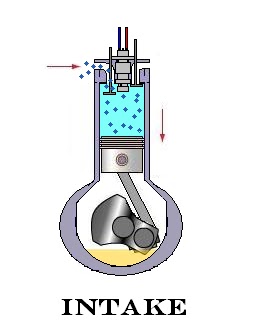
- Compression Stroke- Now the air present is compressed in order to increase the temperature of the air and also of the system.

- Combustion Stroke- Once the piston has completed the combustion stroke, fuel is introduced in which explodes due to high temperature of the system. This drives the piston back and hence combustion stroke comes into play.

- Emission Stroke-Now the piston comes back to remove the waste gases via exhaust port.

Everyone has its pros and cons. Let's talk about the advantages and disadvantages of a diesel engine.
Pros
- Highly fuel efficient engine. Have a greater mileage than that of gasoline engine
- Powerful boost. Diesel engine have less weight to compression ratio of cylinder and hence able to give much horsepower than a gasoline engine of its weight.
- Emit less CO2 and CO
- Produces sooty smoke, full of hydrocarbons leading to acid rain.
- It also generate nitrogenous compound which are very much harmful for the environment.
- These diesel engine has made their image like making clattering sound while moving. This is also posing a negative image on diesel engine while most of the gasoline engine don't produces much sound.
2-stroke engine vs 4-stroke engine

- 2-stroke engines have a significant power boost/supply than a 4-stroke engine as it is fired every 2 revolution and hence can produce double power than a 4-stroke engine.
- 2-stroke engine is lighter in weight due to simple construction than 4-stroke engine. as it don't have any mess with valves or we can say it don't have valves.
- A typical 4-stroke engine can't work in any orientation, in order to resolve it more complexities would be added to it. But in case of 2-stroke engine it will work in any orientation given.
- 2-stroke engines generate more power than 4-stroke engine
- Moreover 2-stroke engines are less expensive than 4-stroke engine.

Disadvantages----
- We all know that 2-stroke engine stroke engine require 4-stroke oil mixed with gas, in order to lubricate the crankshaft, It not only burns gas but also the 2-stroke engine oil with it.
- So 2-stroke engine oil adds to the cost of gas. Hence it becomes very much expensive.
- 2-stroke engines worn out very early than 4-stroke engines due to lack of dedicated lubricating system.
- Sometimes even gas leaks out of the exhaust valve of 2-stroke engine, leading to storage of gas.
- 2-stroke engine not uses the gas efficiently, leading to decrease in mileage of the system.
- 2-stroke engine produces a lot of pollution with it, leading to many environmental pollution.
Working of Two-Stroke Engine
Actually 2-stroke engine work in a very similar way to that of 4-stroke engine. Only there's a difference between the number of strokes or no. of cycles.
In a 2-stroke engine-
First-stroke:
The piston comes down and pressurizes the mixture of oil/air/gas upwards into the combustion chamber, this displaces the extra exhaust.
Now comes the most important stroke i.e. the Second stroke or Compression stroke:
Now the piston moves up, towards the spark plug this creates a vacuum in the crankcase and opens the inlet port & sucks the mixture into the crankcase from the carburetor. Here the piston compresses the mixture which it got in First stroke, the Spark plug ignites the mixture. This drives the piston back and the cycle continues....
See the Diagram while reading this would help you a lot.
In a four-stroke engine, there are separate intake, compression, combustion and exhaust strokes.
You can see here, intake and combustion is occurring at the same time, moreover instead of taking 4-stroke, it is burning the gas in just 2-stroke/cycles. These advantages make two-stroke engines lighter, simpler and less expensive to manufacture. Two-stroke engines also have the potential to pack about twice the power into the same space because there are twice as many power strokes per revolution. The combination of light weight and twice the power gives two-stroke engines a great power-to-weight ratio compared to many four-stroke engine designs.
In a 2-stroke engine-
 |
| Demonstration Of Two Stroke Engine's Working |
First-stroke:
The piston comes down and pressurizes the mixture of oil/air/gas upwards into the combustion chamber, this displaces the extra exhaust.
Now comes the most important stroke i.e. the Second stroke or Compression stroke:
Now the piston moves up, towards the spark plug this creates a vacuum in the crankcase and opens the inlet port & sucks the mixture into the crankcase from the carburetor. Here the piston compresses the mixture which it got in First stroke, the Spark plug ignites the mixture. This drives the piston back and the cycle continues....
See the Diagram while reading this would help you a lot.
In a four-stroke engine, there are separate intake, compression, combustion and exhaust strokes.
You can see here, intake and combustion is occurring at the same time, moreover instead of taking 4-stroke, it is burning the gas in just 2-stroke/cycles. These advantages make two-stroke engines lighter, simpler and less expensive to manufacture. Two-stroke engines also have the potential to pack about twice the power into the same space because there are twice as many power strokes per revolution. The combination of light weight and twice the power gives two-stroke engines a great power-to-weight ratio compared to many four-stroke engine designs.
Working of Four-Stroke Engine
The biggest difference to notice when comparing figures between a 2-stroke engine and 4-stroke engine is that the spark-plug fires once every revolution in a two-stroke engine but in case of four-stroke engine the spark fires once every other revolution. First of all lets discuss about the working of four-stroke engine...
Today most of the cars use what is called Four-Stroke Combustion Cycle to convert gasoline into motion. The four-stroke approach is also known as the Otto cycle, in honor of Nikolaus Otto, who invented it in 1867. They are-
Step 1
The piston starts from the top, the intake valve is opened by the Camshaft, and the piston moves down to let the engine take in a cylinder-full of gasoline and air. Only the tiniest drop of gasoline needs to be mixed into the air for this to work.--------This all Process is called Intake Stroke.

Step 2
Then the piston moves back to compress this fuel & air mixture. This all makes the mixture more denser, internal temperature of the cylinder increases. Hence--------Compression Stroke makes the Explosion more powerful.

Step 3
And when the piston reaches the top of the cylinder, the spark plug emits a spark and ignites the gasoline. The gasoline charge in the cylinder explodes, driving the piston downwards.-------This is called as Combustion Stroke.

Step 4
Once the piston hits the bottom of its stroke, the exhaust valve opens and the exhaust leaves the cylinder to go out the tailpipe.-------This is called Exhaust Stroke.

Today most of the cars use what is called Four-Stroke Combustion Cycle to convert gasoline into motion. The four-stroke approach is also known as the Otto cycle, in honor of Nikolaus Otto, who invented it in 1867. They are-
- Intake Stroke
- Compression Stroke
- Combustion Stroke
- Exhaust Stroke
Working-
Step 1
The piston starts from the top, the intake valve is opened by the Camshaft, and the piston moves down to let the engine take in a cylinder-full of gasoline and air. Only the tiniest drop of gasoline needs to be mixed into the air for this to work.--------This all Process is called Intake Stroke.

Step 2
Then the piston moves back to compress this fuel & air mixture. This all makes the mixture more denser, internal temperature of the cylinder increases. Hence--------Compression Stroke makes the Explosion more powerful.

Step 3
And when the piston reaches the top of the cylinder, the spark plug emits a spark and ignites the gasoline. The gasoline charge in the cylinder explodes, driving the piston downwards.-------This is called as Combustion Stroke.

Step 4
Once the piston hits the bottom of its stroke, the exhaust valve opens and the exhaust leaves the cylinder to go out the tailpipe.-------This is called Exhaust Stroke.

Piston Engine Parts
Now you all know about different types of engines. Now let's start with the Internal Combustion engine's first part i.e. PISTON ENGINE.
Piston Engines are be classified further based on engine's cycle.... Ya, in case of Piston engine we have:
2 stroke engine
4 stroke engine
And, 6 stroke engine
But all of them has somewhat same kind of configuration. So before beginning the lesson let's get introduced with the parts it possesses
Spark Plug
The spark plug supplies the spark that ignites the air/fuel mixture so that combustion can occur. The spark must occur at right moment so that everything work properly.
Piston
Its a cylindrical piece of metal that moves up and down inside the combustion chamber
Crankshaft
When the piston is moved up and down, the converts that motion into a circular motion just like a crank on a jack-in-the-box does.
Valves
Its opens the space from where the mixture of air/fuel enters and the exhaust exits. Actually two valves are present one for the Intake and the other for Exhaust. Note-That both valves are closed during compression and combustion and therefore the combustion chamber is sealed for middle two stroke.
Connecting Rod
It connects the piston to the crankshaft. It can rotate at both ends so that its angle can change as the piston moves and the crankshaft rotates.
Sump
Its around the crankshaft and oil to lubricate the Connecting rod and the crankshaft.
Here's the original of DI-section of an Internal Combustion Engine:
Let start with -
4 stroke engine
Then we'll learn about 2 stroke engine
Then about the advantages & disadvantages between the above two
And, at last we'll see the working of 6 stroke engine
Piston Engines are be classified further based on engine's cycle.... Ya, in case of Piston engine we have:
But all of them has somewhat same kind of configuration. So before beginning the lesson let's get introduced with the parts it possesses
 |
| Illustrated Diagram Of A BASIC Internal Combustion Engine |
Spark Plug
The spark plug supplies the spark that ignites the air/fuel mixture so that combustion can occur. The spark must occur at right moment so that everything work properly.
Piston
Its a cylindrical piece of metal that moves up and down inside the combustion chamber
Crankshaft
When the piston is moved up and down, the converts that motion into a circular motion just like a crank on a jack-in-the-box does.
Valves
Its opens the space from where the mixture of air/fuel enters and the exhaust exits. Actually two valves are present one for the Intake and the other for Exhaust. Note-That both valves are closed during compression and combustion and therefore the combustion chamber is sealed for middle two stroke.
Connecting Rod
It connects the piston to the crankshaft. It can rotate at both ends so that its angle can change as the piston moves and the crankshaft rotates.
Sump
Its around the crankshaft and oil to lubricate the Connecting rod and the crankshaft.
Here's the original of DI-section of an Internal Combustion Engine:
 |
| Di-section Pic OF Internal Combustion Engine |
Let start with -
Internal Combustion Engine
Actually the basic concept behind an Internal Combustion Engine to be called as an Internal Combustion Engine is that the fuel which is available to it is burned inside the core of the engine or in other words the combustion process is carried out internally inside the box of the engine...
The basic principle behind any Internal Combustion Engine-
If you put a tiny amount of high-energy fuel (like gasoline) in a small, enclosed space and ignite it, an incredible amount of energy is released in the form of expanding gas. This large amount of energy can be used to propel a potato to a height of 500 feet. You can also use it for more interesting purposes. Then just think about it, if you can harness this incredible amount of energy in a useful way & could be able to create a cycle that allows you to set off explosions like this hundreds of times per minute, then we have is the basic core of an engine!!!
In fact there are many types of internal combustion engines available today, which uses various different methods to burn the fuel inside the engine. They are based on engine configuration:
 |
| Di-section Of An Piston Engine |
The basic principle behind any Internal Combustion Engine-
If you put a tiny amount of high-energy fuel (like gasoline) in a small, enclosed space and ignite it, an incredible amount of energy is released in the form of expanding gas. This large amount of energy can be used to propel a potato to a height of 500 feet. You can also use it for more interesting purposes. Then just think about it, if you can harness this incredible amount of energy in a useful way & could be able to create a cycle that allows you to set off explosions like this hundreds of times per minute, then we have is the basic core of an engine!!!
In fact there are many types of internal combustion engines available today, which uses various different methods to burn the fuel inside the engine. They are based on engine configuration:
- Piston Engines - Piston Engines are classified further based on engine's cycle...
- Four Stroke Engines - Fuel is burned in 4 stroke of the piston i.e. two times ups and two times downs, with spark every other revolution.
- Two Stroke engines - Fuel is burned in a single revolution i.e. in 2 stroke, one up and one down, with spark every revolution.
- Diesel Engines - Here fuel is also burned in 4 stroke of the piston but without the spark, Yes!!! it doesn't have a spark plug in it. Fuel is burned using internal heat of the cylinder during compression.


- Wankel Engine
- Turbines
Getting confused?!!
Why don't get back and have a brief info about the Classification Of Engine......
Shaft Engine
Shaft engines are those kind of engines which transmits its rotatory power or torque using a Drive Shaft. Drive Shaft are subject to torsion and shear stress.
Drive Shaft has a great history....
Do you remember the old steam locomotives, they used to have a long steel rod mounted on the wheels of the steam engine. It used to slide length-wise and varying its length effectively. Ya, its a kind of drive shaft (as shown in pic) called 'quill drives'.
I remember when i used to go to school, i often see a rotating cylindrical rod beneath a truck. I used to think how this rotating rod is moving the wheels of the truck. Actually that rotating rod is noting but a Drive shaft which is transmitting the power to the wheels.
The above pic shows a pickup truck with 4 wheel drive. You can see two shaft in front of the power assembly which is driving the front tyres.
So all this is Drive Shaft all about....
Now Shaft Engines are of two Types:
Drive Shaft has a great history....
Do you remember the old steam locomotives, they used to have a long steel rod mounted on the wheels of the steam engine. It used to slide length-wise and varying its length effectively. Ya, its a kind of drive shaft (as shown in pic) called 'quill drives'.
 |
| Photo Courtesy TijsB |
I remember when i used to go to school, i often see a rotating cylindrical rod beneath a truck. I used to think how this rotating rod is moving the wheels of the truck. Actually that rotating rod is noting but a Drive shaft which is transmitting the power to the wheels.
 |
| Photo Courtesy troymckaskle |
So all this is Drive Shaft all about....
Now Shaft Engines are of two Types:

